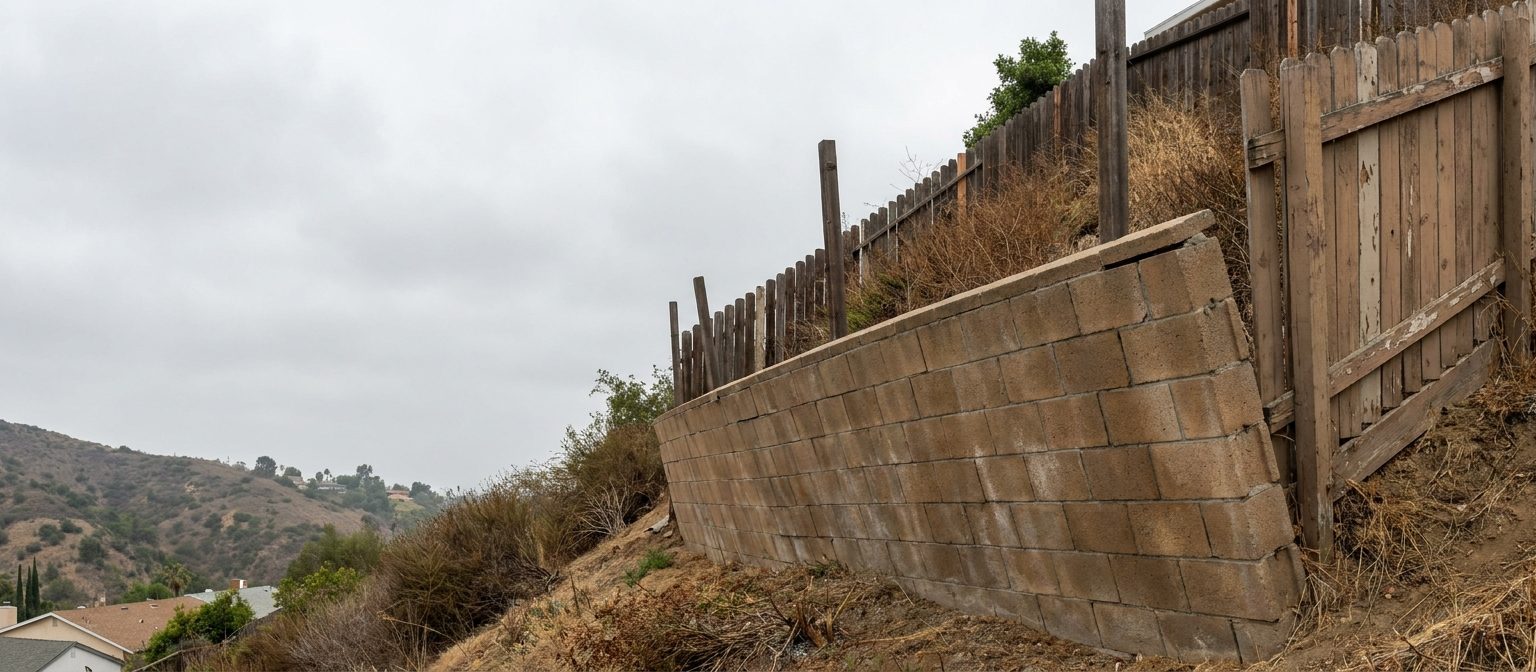
What Does a Leaning Retaining Wall Mean?
A lean is the wall losing an argument with the soil behind it. Every retaining wall is designed to resist a specific lateral pressure; when the actual pressure exceeds that number the wall rotates forward, and it does not rotate back. What you are looking at is a record of movement that has already happened, and usually of movement still happening.
The amount matters less than the pattern. A wall leaning uniformly along its whole run is being pushed. A wall leaning at one end is usually a footing problem. A wall that leans and also shows the crack pattern near the base is bending rather than sliding, and that is a different and more urgent condition.
Why Retaining Walls Lean in Los Angeles
On LA hillside lots the causes repeat with unusual consistency, and almost all of them trace back to water.
- No working drainage. The single most common cause. Without a gravel chimney, filter fabric and a pipe to a legal outlet, saturated soil roughly doubles the pressure on the wall. This is why retrofitting drainage is part of nearly every lean we correct.
- Undersized or shallow footing. A footing that was never sized for the load, or that sits above the frost-free, moisture-stable depth, lets the base rotate.
- Unaccounted surcharge. A driveway, pool, or slope added above the wall after it was built. The wall is now carrying a load nobody designed it for.
- Expansive clay. Much of the LA basin swells when wet and shrinks when dry. That seasonal cycle works a wall forward a little at a time.
- Missing reinforcement. In segmental block walls, geogrid that was skipped or laid too short. In CMU block, rebar that stopped short of where the bending happens.
- Backfill dumped rather than compacted. Loose fill settles, water finds the void, and the wall takes the load the soil should have carried.
Can a Leaning Wall Be Straightened?
Sometimes, and the honest answer depends on what is still sound underneath.
When anchoring works
If the wall structure and footing are intact and the lean comes from soil pressure, anchoring it back can pull it back toward plumb and hold it there. Your planting stays, the wall stays, and the cost is a fraction of a rebuild.
When drainage alone is enough
On a small lean that has stopped progressing, retrofitting drainage to relieve the hydrostatic pressure sometimes ends the movement without touching the wall itself. We monitor through a wet season before calling it done.
When the wall has to come down
If the footing is undersized, the base has rotated, or the wall is also bulging and cracking, anchoring a compromised structure buys time rather than fixing anything. Failing wall replacement is then the cheaper answer over any sensible horizon.
Why nobody simply pushes it back
A leaning wall has moved because the soil behind it moved into the space. Forcing the wall back without relieving pressure or anchoring it just reloads the same failure.
How We Assess a Leaning Wall
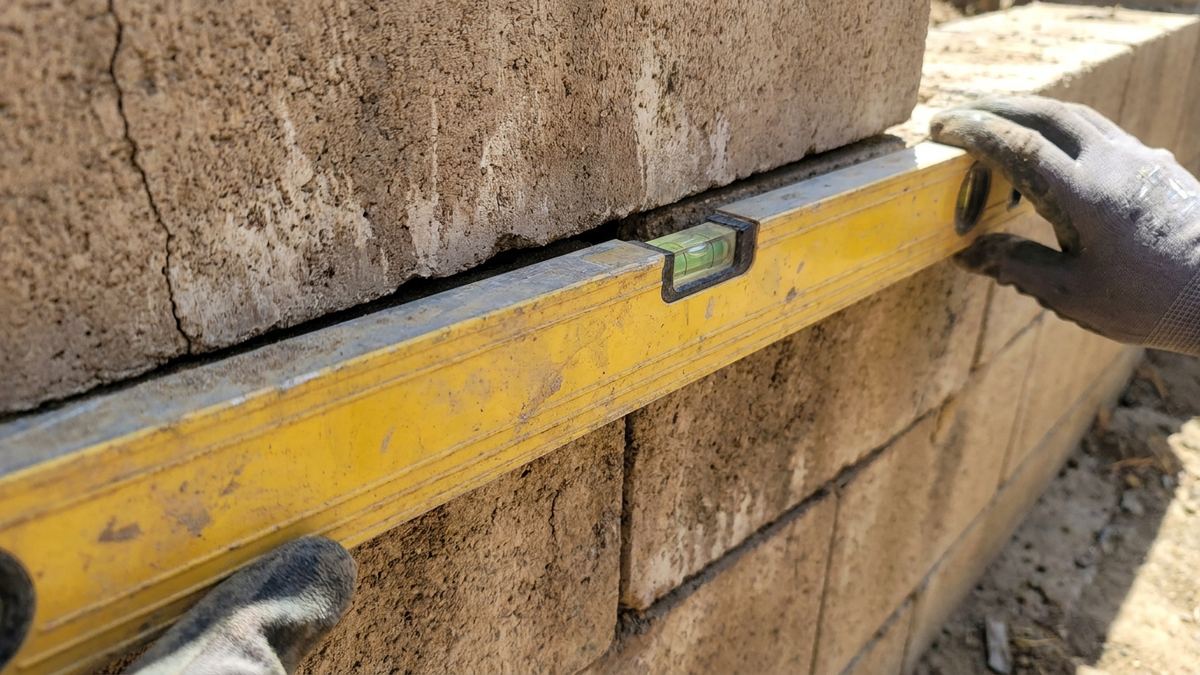
- Measure the lean. Plumb line and level along the run, so we know how much and where — not just that it looks off.
- Read the whole failure. Lean paired with a belly forming mid-run or the crack pattern tells a different story from lean alone.
- Check the drainage. Weep holes, outlets, and where water actually goes in a storm.
- Look at what is above. Surcharge from a driveway, pool or slope frequently explains the whole thing.
- Give a verdict in writing. Anchor, retrofit drainage, or replace — with the reasoning, so you can get a second opinion on the same facts.
Why Choose Us For Leaning Wall Repair?
We measure before we quote
A price without a plumb reading is a guess with a number attached.
We will tell you to replace
If anchoring a compromised wall only buys eighteen months, we would rather lose the smaller job.
Drainage is always in scope
Correcting the lean without fixing the water is why walls get repaired twice.
Anchoring over demolition
Where the wall can be saved, it stays — along with everything planted behind it.
Photos before backfill
Anchors, drainage and compaction documented before anything is covered.
Written workmanship warranty
Handed over at sign-off alongside the manufacturer's material coverage.
Leaning Retaining Wall FAQ's
How much lean is too much?
There is no single number, because it depends on wall height and whether the movement is ongoing. As a working rule, a lean you can see from across the yard on a wall over three feet warrants an assessment now. What matters more is whether it is still moving — which is why we measure rather than eyeball.
Will a leaning wall collapse?
Most do not fail suddenly; they lean further, then bulge, then fail at the point of maximum bending. But a wall retaining a driveway or a slope above a structure is a different risk profile from a garden terrace, and those we treat as urgent.
Can I just push it back and add drainage?
No. The soil has already moved into the space the wall vacated, so forcing it back reloads the same failure. Either the wall is anchored against the new load or it is rebuilt. See wall anchors and tiebacks for how anchoring actually works.
How much does leaning wall repair cost?
Drainage-only correction on a short run is usually a few thousand dollars. Anchored repair on a tall engineered wall runs substantially higher, and full replacing the wall is priced like new construction. Access on a hillside lot moves the number more than anything else.
Do I need a permit to fix a leaning wall?
Structural repair — anchors, rebuilding, or anything changing how the wall carries load — usually does. Requirements differ between LADBS, LA County, and cities like Pasadena, Glendale and Burbank that run their own building departments. We confirm for your address before quoting.
Is a leaning wall covered by insurance?
Rarely. Most policies exclude earth movement and gradual deterioration, which covers the overwhelming majority of leaning walls. A wall damaged by a sudden covered event is a different conversation — worth asking your carrier, but do not budget on it.
Related Retaining Wall Repairs
Wall problems rarely arrive alone. A lean usually comes with a drainage failure, and a bulge usually comes with cracking — so the repair that fixes your wall is frequently two of these working together. Each page below covers how that condition is diagnosed and what the repair actually involves, or start from the retaining wall repair overview.