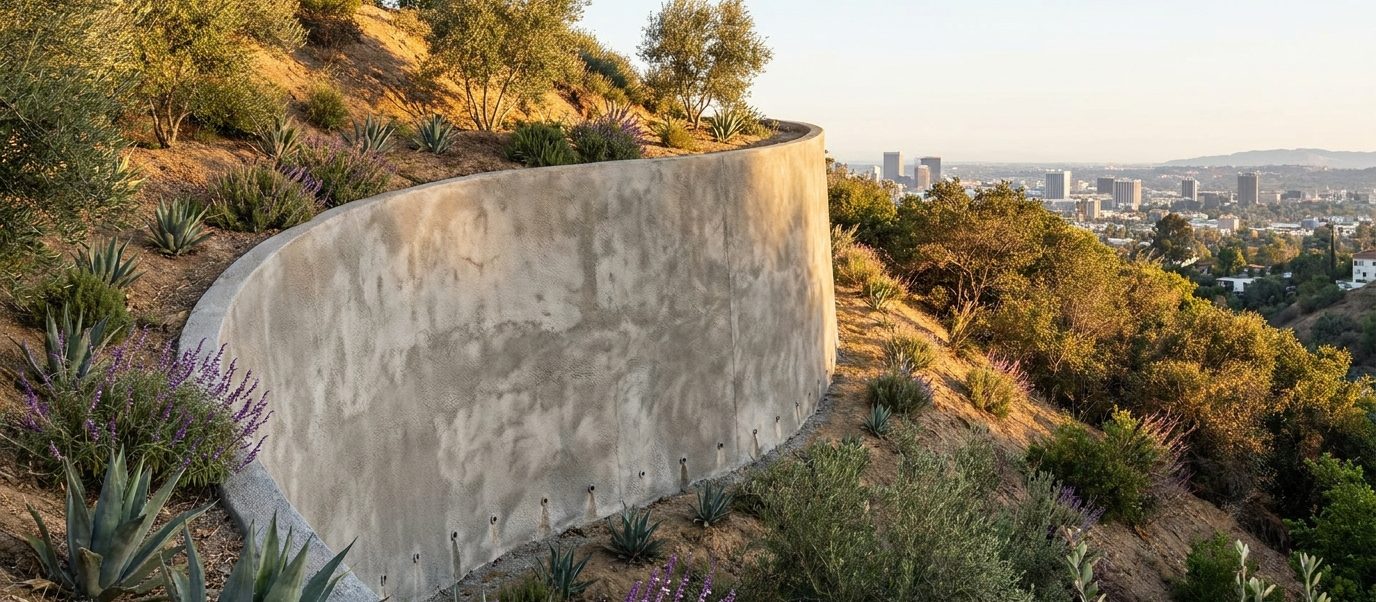
What Is a Shotcrete Retaining Wall?
Shotcrete is concrete conveyed through a hose and sprayed at high velocity against a prepared face. Structurally it is concrete — same materials, comparable strengths — but it is placed rather than poured, which removes the need for two-sided formwork and lets the wall follow ground that formwork could never reasonably follow.
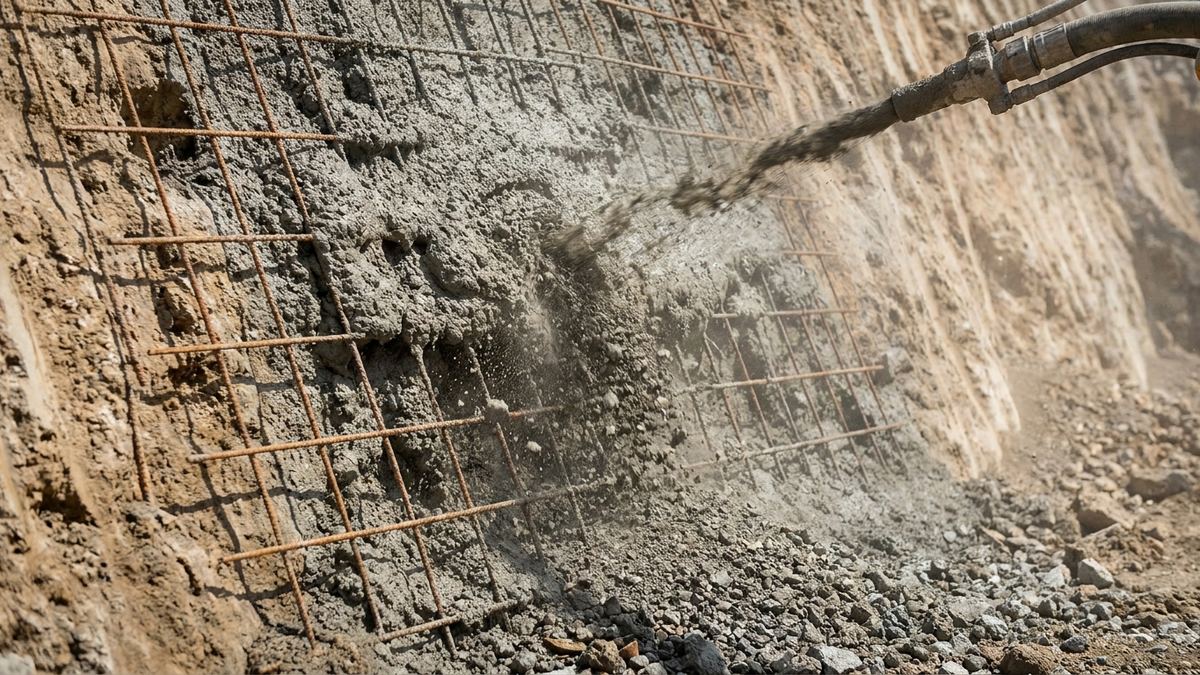
On a steep Los Angeles canyon lot that difference decides projects. Where erecting and bracing formwork for a poured concrete wall would mean cutting a working platform into the slope, shotcrete is applied directly against the excavated face over a mat of reinforcing steel — and the wall takes the shape of the hillside instead of fighting it.
Where Shotcrete Earns Its Place
- Steep canyon lots. Where access and gradient make conventional forming impractical or genuinely unsafe. Common across hillside retaining walls work.
- Curved and irregular faces. The wall follows the excavation. Formwork has to be built to a shape; shotcrete adopts one.
- Facing for soil nails and anchors. Shotcrete is the standard structural facing over a nailed or anchors and tiebacks slope, tying the elements into a continuous surface.
- Slope stabilisation. Where the objective is holding an entire cut face rather than retaining behind a discrete wall line.
- Tight access. Material is pumped through a hose, so the mixer does not need to reach the wall.
- Where it is not right. Low garden walls and anything where a segmental block or timber wall would be simpler and cheaper. Shotcrete is specialist work priced accordingly.
How a Shotcrete Wall Is Built
Cut and prepare the face
The slope is excavated to profile and cleaned. On tall faces this proceeds in stages, top down, so the slope is never unsupported over a large height at once.
Reinforcing mat and connections
Steel mesh or bar mat pinned to the face and tied into soil nails, dowels or anchors and tiebacks where the design requires them.
Spray and shape
Concrete applied in controlled layers, encasing the steel fully, then screeded or hand-finished. The finish is a decision — natural gun finish, troweled smooth, or sculpted and coloured to read as rock.
Drainage through the wall
Composite drain strips or fabric behind the face and weep pipes through it, because a sprayed wall is as impermeable as a poured one. Skipping this produces the same cracking a poured wall would show.
How We Deliver Shotcrete Work
- Soils report and engineering. Effectively mandatory on the slopes where shotcrete makes sense. See hillside retaining walls.
- Staged excavation. Sequenced so the cut face is supported as work proceeds.
- Steel placed and inspected. Mat, nails and dowels signed off before any concrete is sprayed.
- Spray in controlled layers. With attention to encasement and rebound, which is where quality is won or lost.
- Drainage and finish. Drain strips, weeps, then the specified surface treatment.
- Documentation. Test panels where required, plus photography of the steel before it disappears.
Why Choose Us For Shotcrete Retaining Walls?
We work from a soils report
On the slopes shotcrete suits, guessing is not an option.
Staged, supported excavation
The cut face is never left open longer than the design allows.
Full encasement of steel
Rebound and shadowing behind bars is the classic shotcrete defect.
Drainage designed in
A sprayed wall is impermeable; the water has to be given a route.
Finish options shown
Gun finish, troweled or sculpted — decided before, not discovered after.
Written workmanship warranty
At sign-off with the manufacturer's material coverage.
Shotcrete Retaining Wall FAQ's
Is shotcrete as strong as poured concrete?
Yes, when placed properly — comparable compressive strengths and the same reinforcement principles. The variable is workmanship: encasement of the steel and control of rebound matter more in shotcrete than mix design does.
Why is shotcrete used on hillsides?
Because it needs no two-sided formwork and can be applied directly against a cut face. On a steep canyon lot, building and bracing formwork for a concrete retaining walls wall may require more excavation than the wall itself.
What does a shotcrete wall look like?
Whatever you specify. Left as sprayed it has a mottled natural texture; it can be screeded flat, troweled smooth, or carved and coloured to imitate rock. The finish is chosen at design stage because it affects the crew and the cost.
Is shotcrete expensive?
Per square foot, more than segmental block and comparable to or above poured concrete. It becomes the economical choice when the alternative involves excavating a working platform into a slope, which is frequently the case on the lots where it is specified.
Does shotcrete need drainage?
Absolutely. It is as impermeable as poured concrete, so composite drain strips behind the face and weeps through it are part of the design. Without them the wall carries a full hydrostatic load and will show cracking.
Can shotcrete be used to repair an existing wall?
Sometimes — as a structural overlay over a face that is intact but underdesigned, usually combined with anchors and tiebacks. Where the underlying wall has rotated or the footing is inadequate, replacement remains the honest answer.
Other Retaining Wall Types We Build
Most Los Angeles projects end up using more than one system — mortared CMU wall along the property line, segmental block stepping down the garden, poured concrete stem wall carrying the driveway. Each page below covers what that system is, where it is the right call and where it is not, or start from the retaining wall types overview.