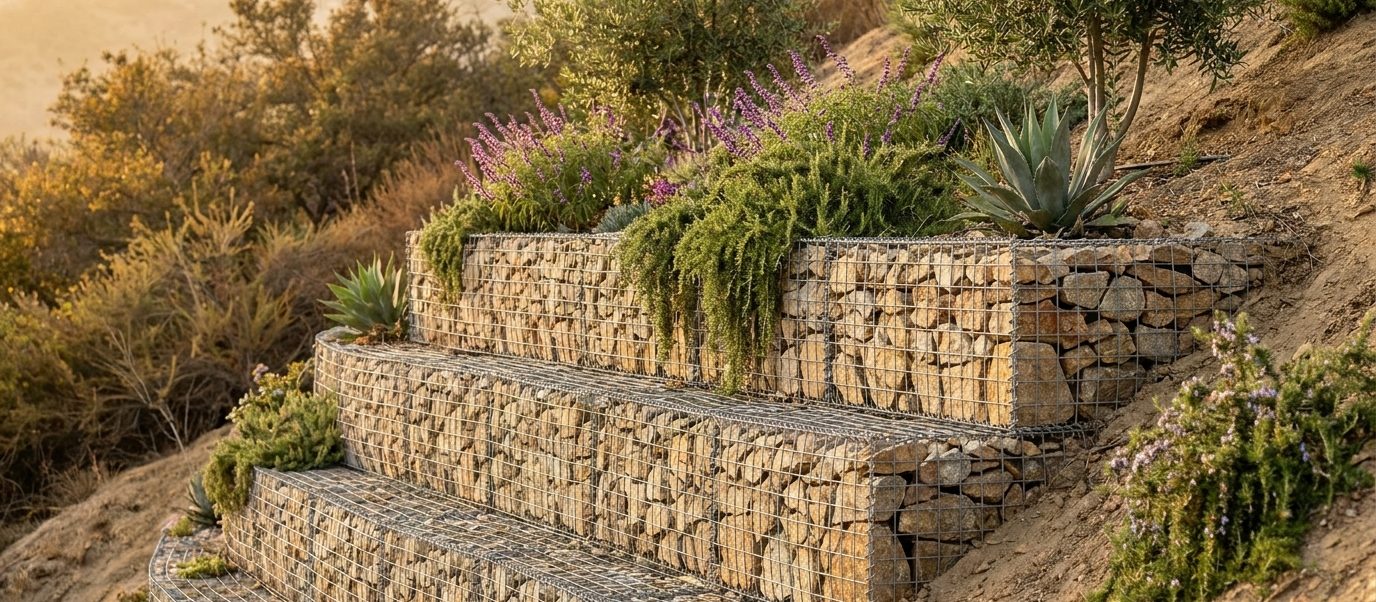
What Is a Gabion Retaining Wall?
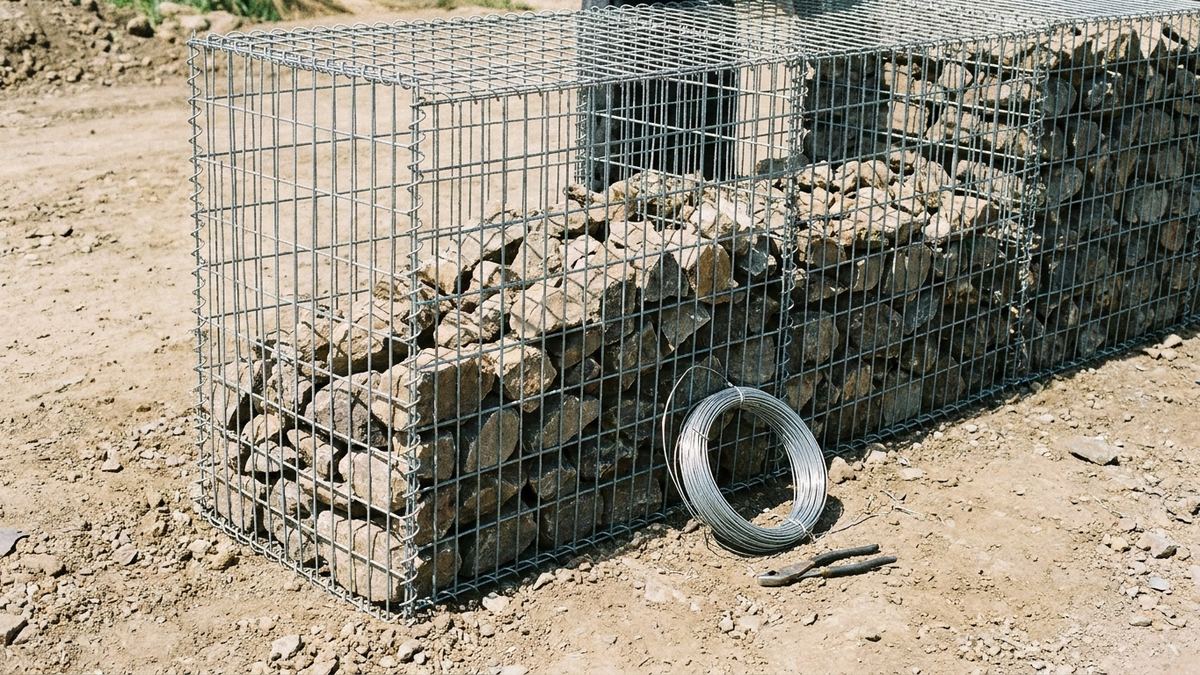
A gabion wall is built from galvanised welded or woven wire baskets filled with angular rock and laced together into a continuous mass. It retains by weight, like any gravity wall, but with two properties no other system shares: it drains completely through itself, and it deforms without failing.
Those two properties are why gabions turn up on difficult ground. Where a rigid poured concrete or CMU block wall would crack as the ground moved, a gabion wall settles and keeps working. Where any other system needs a gravel chimney and a pipe, a gabion wall is the drainage.
Where Gabion Walls Make Sense
- Ground that moves. Creeping slopes, old fill and expansive clay. A gabion deforms rather than cracking, which is the opposite of how mortared CMU walls behaves on the same ground.
- Constant or seasonal water. Channel edges, drainage swales and slopes with persistent seepage, where the free-draining structure removes the hydrostatic problem entirely.
- Erosion control. Canyon lots and watercourse banks, particularly below burn scars where debris flow is a design condition. Relevant across hillside retaining walls.
- Where the look suits. Rugged, industrial-agricultural, and it plants beautifully — creeping species over the top course soften it within a season.
- Speed without curing. No concrete to cure, so the wall carries load as soon as it is built.
- Where it is not right. Formal gardens, tight property-line walls where the basket depth costs usable space, and anywhere a smooth finish is wanted. Mortared CMU walls or stone and boulder walls suits those better.
How a Gabion Wall Is Built Properly
Baskets and mesh specification
Galvanised, and PVC-coated in corrosive or coastal conditions. The wire is the structure — a cheap mesh specification is the one thing that genuinely shortens a gabion wall's life.
Hand-packed faces
Face stones placed individually so the visible surface is tight and flat, with the interior machine-filled. The difference between a hand-faced wall and a tipped one is enormous and entirely visual.
Correct rock
Angular, durable, and sized so it cannot pass through the mesh — typically well-graded rock somewhat larger than the aperture. Rounded river rock does not interlock and should not be used.
Lacing and stepping
Baskets laced together at every edge so the wall acts as one mass, and stepped back into the slope like any other gravity wall.
How We Deliver Gabion Work
- Assess the ground. Gabions are frequently specified because the ground is difficult, so understanding it comes first.
- Prepare a level base. Compacted, with geotextile beneath so fines do not migrate up into the rock.
- Assemble and lace. Baskets built in place and laced at every joint rather than stacked loose.
- Hand-face and machine-fill. Faces packed by hand, interiors filled and compacted in lifts, lids laced closed.
- Backfill and step. Compacted behind, with the wall stepped into the slope as designed.
- Plant if specified. Soil pockets and creeping planting where the wall is meant to green over.
Why Choose Us For Gabion Retaining Walls?
Mesh specified for the site
Galvanised as standard, PVC-coated near the coast.
Faces packed by hand
The single visual difference between a good gabion wall and a bad one.
Correct rock, correctly graded
Angular and sized to the aperture, not whatever was cheapest to deliver.
Laced at every joint
So the wall behaves as one mass rather than a stack of boxes.
Geotextile beneath and behind
Keeping fines out of the rock so it keeps draining.
Written workmanship warranty
At sign-off with the manufacturer's material coverage.
Gabion Retaining Wall FAQ's
How long do gabion walls last?
The rock is permanent; the wire is the clock. Galvanised mesh in normal inland conditions gives decades, and PVC-coated mesh considerably longer in coastal or corrosive settings — which is why specification matters more here than in any other system.
Do gabion walls need drainage behind them?
No separate drainage system, which is their defining advantage. The structure is free-draining, so there is no hydrostatic build-up — the failure mode behind most leaning and bulging repairs simply does not apply.
Are gabion walls cheaper?
Materially competitive with block retaining walls, but labour-intensive if the faces are hand-packed properly. A tipped-fill gabion wall is cheap and looks it; a hand-faced one costs more and looks like a considered piece of landscape.
Can gabion walls be planted?
Yes, and they are among the best systems for it. Soil pockets in the upper baskets with creeping planting will green the face substantially within a season or two, which is often the whole reason they are chosen.
How tall can a gabion wall be?
As a gravity structure, height is a function of base width — so tall gabion walls get thick, quickly. Beyond a few tiers the base footprint becomes the limiting factor on a residential lot, and concrete retaining walls or shotcrete uses the space more efficiently.
Will the baskets rust?
Galvanising protects the wire for decades inland. Near the coast, or where soil or water is corrosive, PVC-coated mesh is specified instead. Using uncoated mesh in the wrong environment is the main way a gabion wall fails early — and it is a specification error, not a material limitation.
Other Retaining Wall Types We Build
Most Los Angeles projects end up using more than one system — mortared CMU wall along the property line, segmental block stepping down the garden, shotcrete face where the slope is too steep to form. Each page below covers what that system is, where it is the right call and where it is not, or start from the retaining wall types overview.