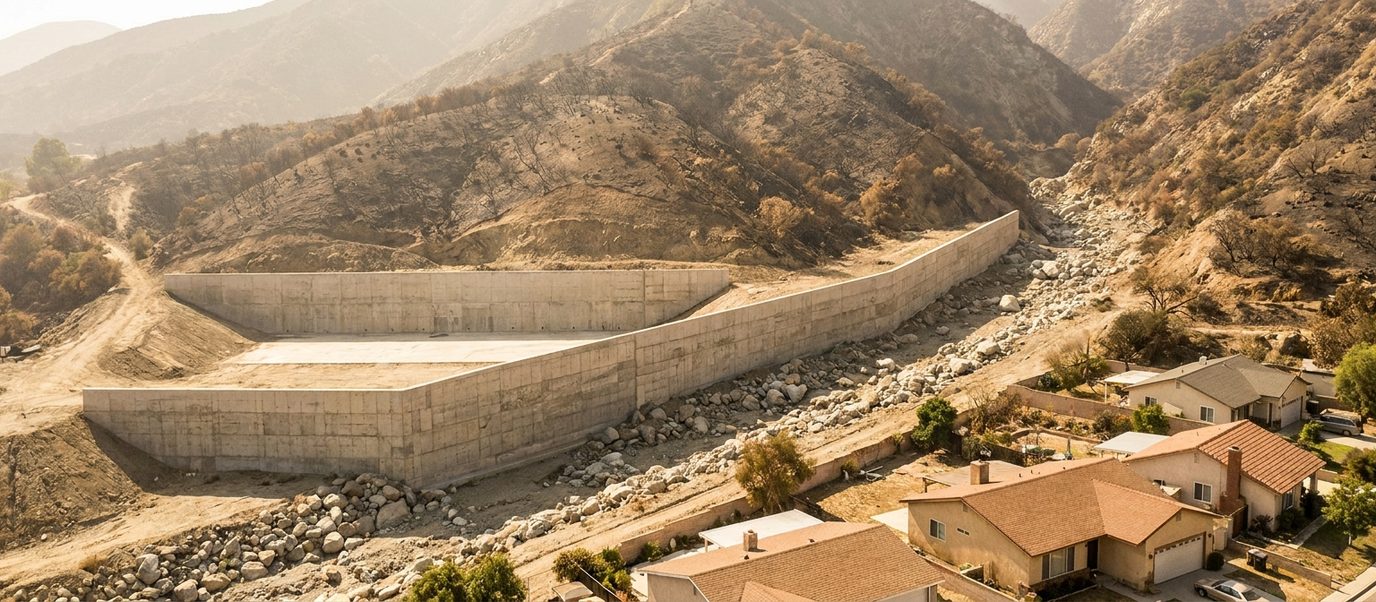
What Is a Debris Flow?
A debris flow is a fast-moving slurry of water, soil, rock and vegetation travelling down a canyon or drainage course. It is not a landslide and it is not a flood — it has the density of wet concrete and the speed of running water, and it carries boulders and trees that a flood would leave behind. It arrives in minutes, it follows the drainage, and it stops when the ground flattens out, which on a foothill lot is often exactly where the house is.
In Los Angeles the trigger is usually fire followed by rain. A burned slope loses the vegetation that held its surface and develops a water-repellent soil layer that sheds rainfall instead of absorbing it, so a storm that would have been unremarkable before the fire delivers several times the runoff and a great deal of loose material with it. The elevated risk persists for a number of wet seasons while the slope revegetates — which is why slope stabilization above a property is part of the same conversation.
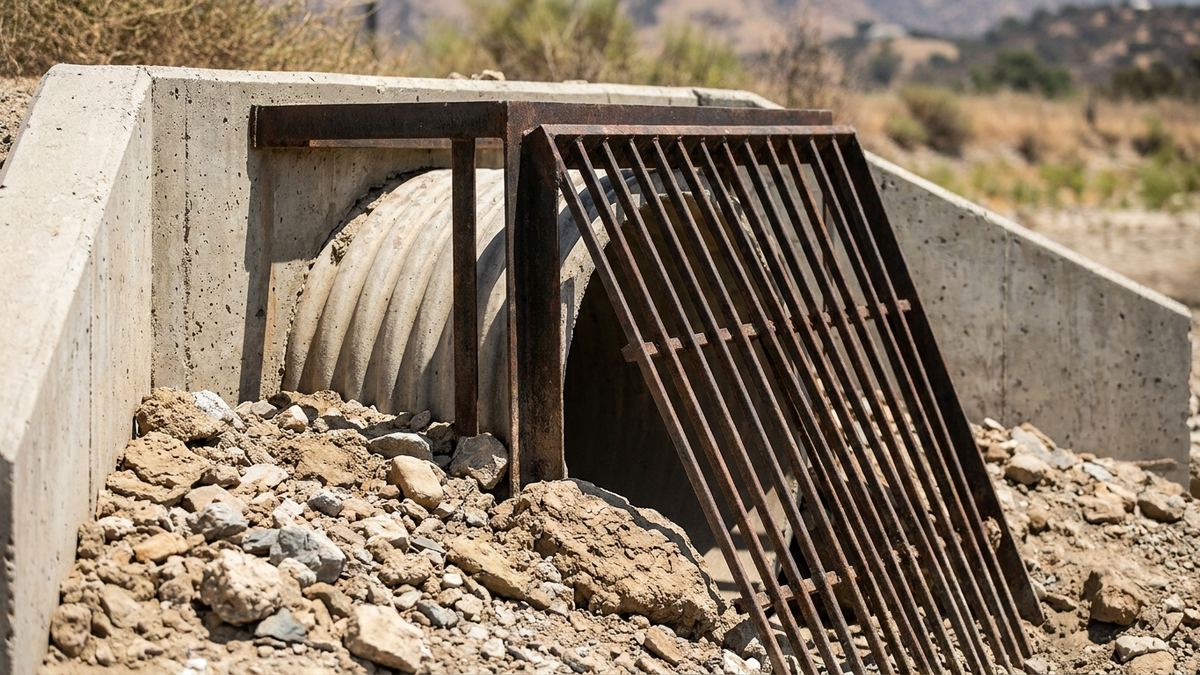
What Protection Actually Looks Like
There are only a few strategies, and the site geometry decides which are available.
- Deflection walls. Angled reinforced walls that redirect flow past a structure rather than trying to stop it. Deflecting is far cheaper than containing, and where the geometry allows it, it is usually the right answer.
- Debris basins and catchment. An excavated and walled area upslope that holds material and lets water pass through a rack and outlet. Effective, space-hungry, and only useful if someone empties it.
- Channels and swales. Lined channels that keep flow in a defined path across a property, sized for debris rather than for clear water — the two are not the same calculation.
- Reinforced structures on the impact side. Concrete retaining walls and shotcrete walls on the exposed face of a structure, designed for impact loading rather than for soil pressure.
- Barriers and fences. Engineered flexible barriers in a canyon above the property, where there is somewhere to anchor them.
- Slope treatment upstream. Revegetation, matting and check dams reduce what is available to move in the first place. The slowest measure and the most durable.
Who Needs to Think About This
Properties below a burned slope
The clearest case, and a time-limited one — the risk is highest in the first wet seasons after a fire and declines as vegetation returns.
Homes at a canyon mouth
Where a drainage course opens onto flatter ground, material drops. If a property sits at that point, it sits in the deposition zone whether or not anything has happened recently.
Foothill properties in the San Gabriel and Verdugo fronts
Steep, geologically young canyons that produce debris flows as a matter of course rather than as an anomaly. The historical record in these foothills is long.
Anywhere the drainage has been altered
Upstream development, a filled channel or a redirected swale can put a property in a flow path it was never in before.
Where a wall is the wrong tool
A standard retaining wall is designed for static soil pressure, not for impact from a moving mass. Assuming an existing garden wall offers protection is the most common and most dangerous misreading of this risk.
How We Approach Debris Protection
- Read the drainage, not just the lot. Where the canyon above discharges, how it has behaved historically, and what has changed upstream.
- Be clear about what a measure can do. Deflection, containment and reduction are different objectives with different costs. Conflating them helps nobody.
- Design for impact, not for soil. Structures in a flow path are engineered for dynamic loading, which is a different calculation from a retaining wall and needs engineering to match.
- Keep outlets serviceable. A basin or rack that cannot be cleared is a basin that works once.
- Coordinate with what the agencies do. Los Angeles County operates a substantial debris basin system. What is already in place upstream changes what is sensible on a private lot.
- Work to the calendar. Post-fire protection is worth doing before the first significant rain. After it, the useful question changes.
Why Choose Us For Debris Flow Protection?
Honest about residual risk
No structure makes a property in a flow path risk-free, and we will not imply otherwise.
Deflection preferred where geometry allows
Because it is usually more effective per dollar than containment.
Engineered for impact loading
Not a retaining wall relabelled.
Maintenance designed in
Access to clear a basin or a rack, because that is what keeps it working.
Scheduled around the rains
Protection is worth little if it is finished in February.
Written workmanship warranty
At sign-off, in plain language.
Debris Flow Protection FAQ's
Will a retaining wall stop a debris flow?
Not by itself, and this is the most important thing on this page. An ordinary segmental block or poured concrete wall is designed for static soil pressure; a debris flow applies dynamic impact loading with boulders in it. Protection structures are designed for that specific load case, and a wall that was not is not protection.
How long does the risk last after a fire?
Elevated for several wet seasons, with the first one after the burn generally the worst. As vegetation and root structure return the runoff behaviour moves back towards normal, but the recovery is measured in years rather than months.
Are sandbags enough?
For shallow mud and water in a low-risk position, they help. Against an actual debris flow with rock and vegetation in it, they are not a structural measure. They are worth deploying and they are not worth relying on.
Do I need a permit for a deflection wall?
Yes, and these structures usually need engineering, because they are designed for a load case that has to be justified. Work in or near a drainage course can also involve agencies beyond the building department.
What about the debris basins the County operates?
Los Angeles County maintains a large network of them, and if your property sits below one the risk profile is different from a property below an unprotected canyon. Finding out which applies is a sensible first step before commissioning anything private.
Can slope planting reduce the risk?
Over time, meaningfully — it is what returns a burned slope to normal behaviour. It does very little in the first season, which is the season that matters most, so it is a companion to structural measures rather than a substitute. See slope stabilization for how that work is staged.
The Rest of the Hillside Picture
A hillside wall is rarely the whole problem: what the slope is doing decides whether a wall is even the right tool, how the site is shaped decides how much wall you need, what the wall is founded on decides how tall it can go. Each page below covers one of those in detail, or start from the hillside retaining walls overview.