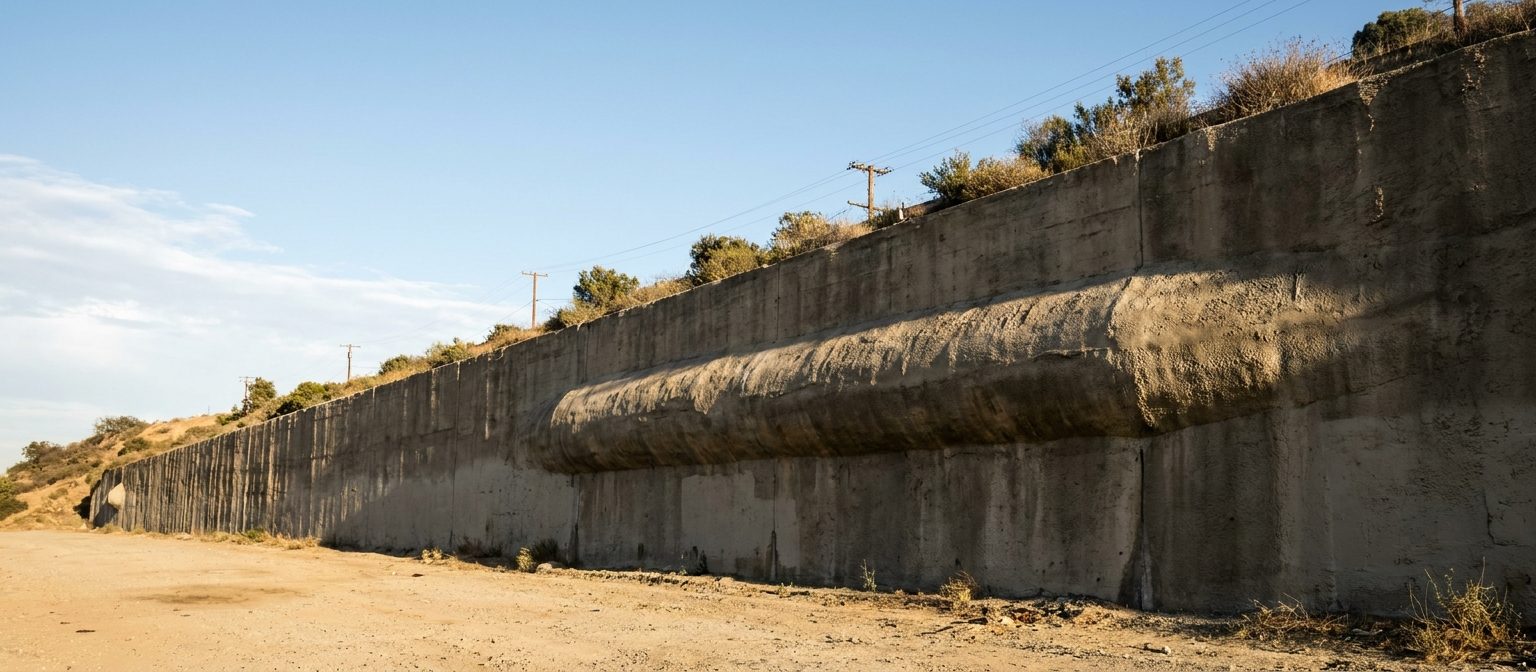
What Is a Bulging Retaining Wall?
A bulge is deflection. The wall is not sliding forward as a unit the way a wall that has started to lean does — it is bending, held at the base and at the ends while the middle pushes out. Sight along the face and the curve is unmistakable; look straight at it and you may see nothing at all.
That distinction matters because bending concentrates stress. The material at the outside of the curve is in tension, which is exactly where concrete and mortar are weakest, and it is why a bulge so often appears alongside horizontal cracking. If you are seeing both, read wall crack repair as well.
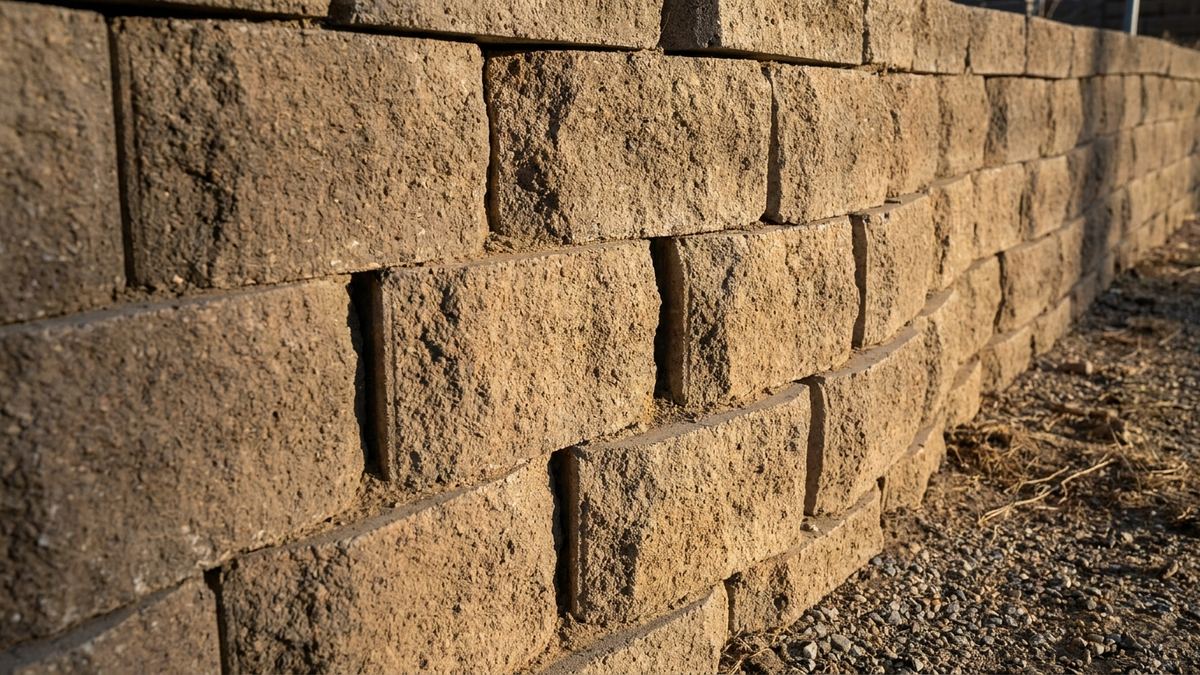
What Causes a Wall to Bow Outward?
Bulging says something specific: the wall has enough restraint at the base and ends but not enough in the middle.
- Missing mid-height reinforcement. In segmental block, geogrid layers omitted at the courses that needed them. In CMU block, rebar that stopped short or was never grouted solid.
- Hydrostatic pressure. Water behind the wall loads it as a distributed pressure, which is precisely the load case that produces a belly. Drainage retrofit addresses the cause rather than the symptom.
- Point surcharge above. A driveway edge, pool deck or footing bearing on one section pushes that section harder than the rest.
- Wall too tall for the system. A dry-stacked wall built above the unreinforced height limit will bow long before it slides.
- Freeze-thaw and clay cycling. Repeated seasonal swelling works the middle of a run outward a fraction at a time.
- Backfill compacted with heavy plant. Over-compaction directly behind a wall can push it outward during construction and leave it pre-loaded.
How We Repair a Bulging Wall
Anchoring the bulge
Wall anchors and tiebacks installed through the belly, tensioned to arrest the deflection and carry the load the reinforcement should have carried. This is the standard fix where the wall is otherwise sound.
Relieving the pressure
Excavating behind the wall and retrofitting drainage so the wall is no longer resisting a water load it was never designed for. Frequently paired with anchoring rather than used alone.
Rebuilding the bulged section
Where deflection is severe, the affected run comes out and goes back with the correct reinforcement. Cheaper than a whole-wall replacing the wall when the rest is genuinely sound.
Changing the wall type
On a run that has bowed because the system was wrong for the height, rebuilding in poured concrete or CMU block with proper reinforcement is more durable than repairing what is there.
How We Assess a Bulging Wall
- Sight and measure the deflection. Along the run with a string line, so the belly is a number rather than an impression.
- Locate the maximum. Where the bulge peaks tells us which reinforcement layer is missing or overloaded.
- Check for cracking at the belly. Horizontal cracking at maximum deflection means the wall is at the limit of what it can bend.
- Trace the water. Weep holes, staining and where the ground stays wet after rain.
- Identify the surcharge. What sits above the bulge, and whether it was there when the wall was built.
Why Choose Us For Bulging Wall Repair?
We string-line the run
A bulge measured is a bulge that can be tracked; an eyeballed one cannot.
We fix the load, not the look
Rendering over a belly hides a bending failure and changes nothing.
Drainage always in scope
A wall bowing under water pressure keeps bowing until the water is dealt with.
Partial rebuild where it fits
If only one run has failed, only that run comes out.
Photos before backfill
Anchors, reinforcement and drainage documented before they disappear.
Written workmanship warranty
Handed over at sign-off with the manufacturer's material coverage.
Bulging Retaining Wall FAQ's
Is a bulging wall more serious than a leaning one?
Usually, yes. Leaning retaining wall can be a wall moving as a rigid unit, which is bad but predictable. A bulge means the wall is bending, and bending failures concentrate stress at one point. A wall with a pronounced belly is closer to failure than a wall with an equivalent lean.
Can a bulge be pushed back?
Not usefully on its own. The soil has already filled the space. Anchoring pulls the deflection back under control while carrying the load going forward — see wall anchors and tiebacks for the method.
Why does the bulge appear in the middle?
Because the wall is restrained at the base and often at the ends, so the middle has the least support and the greatest span. That is also where a missing geogrid or rebar layer shows up first.
Do I need to replace the whole wall?
Not always. Where the rest of the run is sound and correctly built, we rebuild only the bulged section. Where the same reinforcement is missing throughout, failing wall replacement is the honest recommendation.
How urgent is it?
A bulge holding a driveway, pool or slope below a structure is urgent. A garden terrace with a small belly can usually be monitored while you plan. We will tell you which you have rather than treating everything as an emergency.
Will it keep getting worse?
Unless the cause is removed, yes — and deflection accelerates as the wall loses stiffness. That is why every repair we quote starts with why it bowed rather than how to make it look straight.
Related Retaining Wall Repairs
Wall problems rarely arrive alone. A lean usually comes with a drainage failure, and a bulge usually comes with cracking — so the repair that fixes your wall is frequently two of these working together. Each page below covers how that condition is diagnosed and what the repair actually involves, or start from the retaining wall repair overview.