What Is a Drainage Retrofit?
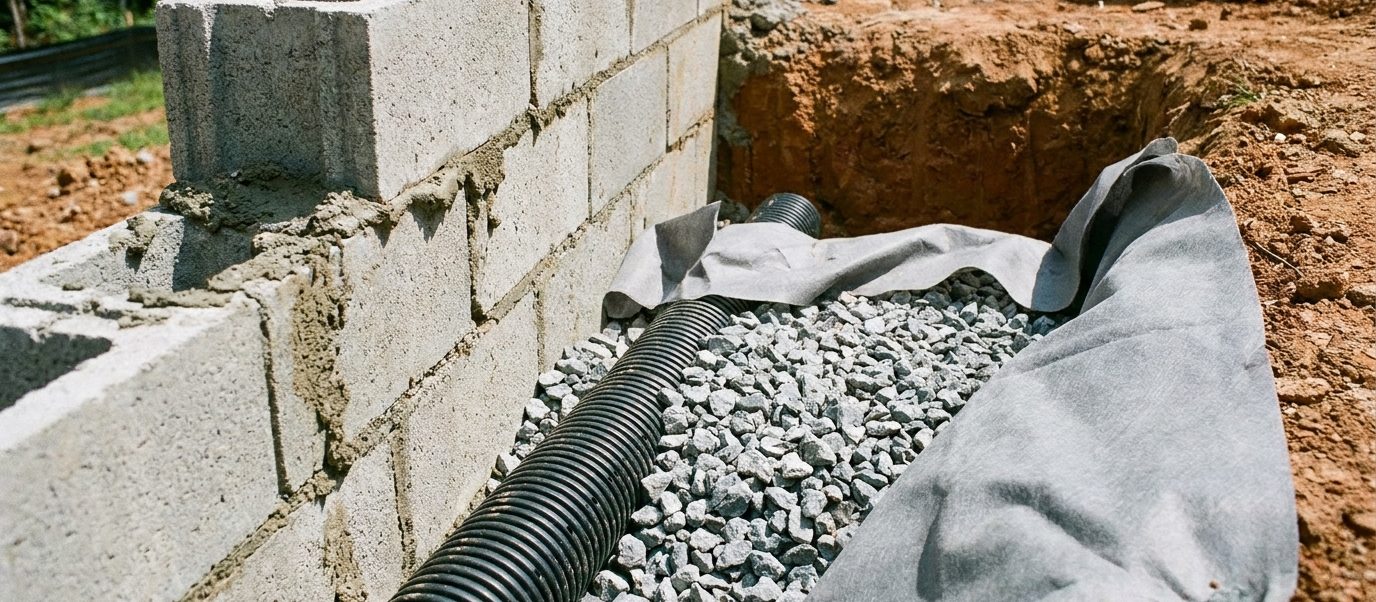
A drainage retrofit is the installation of a working drainage system behind a retaining wall that was built without one, or whose original system has silted up. Gravel chimney against the back of the wall, geotextile filter fabric to keep fines out of it, perforated pipe at the base, and a discharge point that actually goes somewhere legal.
It is unglamorous and it is the most consequential repair we do. Saturated soil roughly doubles the lateral pressure on a wall, so a wall designed for dry conditions is carrying twice its design load every wet winter. Almost every a wall that has started to lean, a belly forming mid-run and cracked wall we assess traces back to this.
Why Drainage Fails on Los Angeles Walls
- It was never installed. Extremely common on walls built as landscaping rather than structure, particularly pre-1980s garden walls across the Valley and the foothill cities.
- The gravel was omitted or too thin. A pipe with no gravel envelope around it drains almost nothing.
- No filter fabric. Without it, fines migrate into the gravel and the chimney silts up solid within a few seasons.
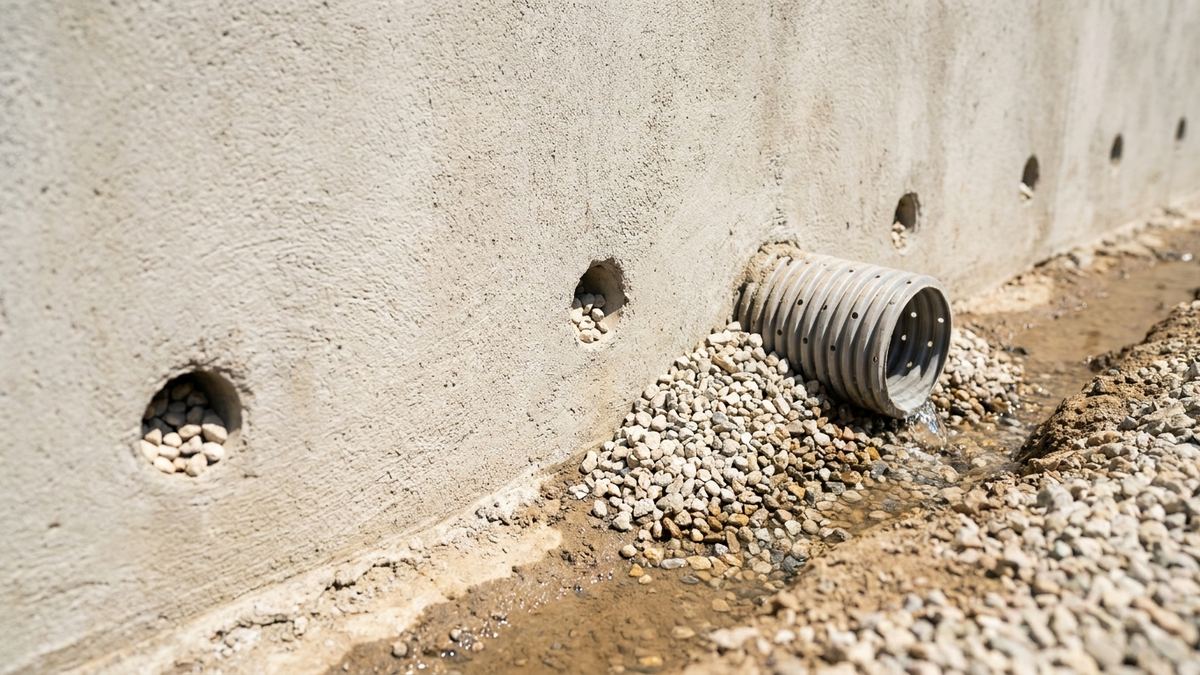
- Weep holes blocked. Soil, roots and debris close them off, and nobody looks at them until the wall moves.
- The outlet goes nowhere. A pipe that discharges into the backfill, or into ground that is already saturated, is decorative.
- LA storms arrive all at once. Systems sized for average rainfall are overwhelmed by the handful of intense events that deliver most of the year's water.
What a Retrofit Involves
Excavating behind the wall
The working strip has to be opened up. This is the real cost and the real disruption — planting in that band comes out, and we mark the width at the estimate rather than discovering it on the day.
Gravel chimney and filter fabric
Clean angular drainage rock against the back of the wall, wrapped in geotextile so it stays clean and keeps working.
Perforated pipe and legal discharge
Pipe at the base, laid to fall, running to a point that discharges without dumping water onto a neighbour — which is a code issue as well as a courtesy one.
New weep holes
Core-drilled through poured concrete or CMU block where the wall face allows it, giving water a second route out.
Compacted backfill in lifts
The strip goes back in layers, compacted, so it does not settle over the first winter and leave a channel for water.
When Drainage Alone Is Enough
Sometimes it genuinely is the whole repair — and knowing when saves you a great deal of money.
- The wall has not moved. Weeping and efflorescence without lean, bulge or horizontal cracking means you have caught it early.
- Movement has stopped. A small historic lean that has been stable for years can often be left alone once the water is dealt with.
- Cracking is cosmetic. Vertical hairlines only — see wall crack repair for how we tell the difference.
- The structure is otherwise sound. Adequate footing, correct reinforcement, appropriate height for the system.
- When it is not enough. Active movement usually needs wall anchors and tiebacks alongside the drainage, and a wall with an inadequate footing needs replacing the wall regardless of how well it drains.
Why Choose Us For Drainage Retrofit?
We treat drainage as structural
Because it is. Water is the load that breaks most LA walls.
Sized for storm peaks
Not for the annual average, which is not how rain arrives here.
Legal discharge, every time
A retrofit that moves your problem onto a neighbour is not a repair.
Working width agreed up front
You know what planting comes out before we start, not after.
Photos before backfill
Gravel, fabric, pipe and falls documented before the strip closes.
Written workmanship warranty
At sign-off, alongside the manufacturer's material coverage.
Drainage Retrofit FAQ's
Will a drainage retrofit stop my wall moving?
If water is the only reason it moved and the structure is otherwise adequate, frequently yes. If the wall is already leaning or bulging under its own inadequacy, drainage removes the aggravating load but does not restore capacity — that is what wall anchors and tiebacks is for.
Do I have to dig up my garden?
The strip directly behind the wall, yes. There is no way to install a gravel chimney and a pipe from the front. We mark the working width at the estimate so you can decide what to lift and keep beforehand.
Can you just drill weep holes instead?
Weep holes help and we install them, but on their own they drain only what reaches them. Without a gravel chimney behind the wall, water in the backfill has no path to the holes. It is a partial measure, and we will say so rather than sell it as a fix.
Where does the water actually go?
To a legal discharge point — a storm drain connection, a swale, or daylight at a lower elevation on your own property. Discharging onto a neighbouring parcel creates a liability, so the outlet is part of the design rather than an afterthought.
How much does a drainage retrofit cost?
Less than anchoring and far less than replacing the wall, with excavation and access driving most of it. On a hillside lot where a machine cannot reach the back of the wall, hand excavation changes the number substantially.
Do new walls need this?
No — on anything we build, the gravel chimney, fabric, pipe and legal outlet are in the base scope from the start. See retaining wall installation for how drainage is built into a new wall rather than retrofitted into an old one.
Related Retaining Wall Repairs
Wall problems rarely arrive alone. A lean usually comes with a drainage failure, and a bulge usually comes with cracking — so the repair that fixes your wall is frequently two of these working together. Each page below covers how that condition is diagnosed and what the repair actually involves, or start from the retaining wall repair overview.