What Is Retaining Wall Drainage?
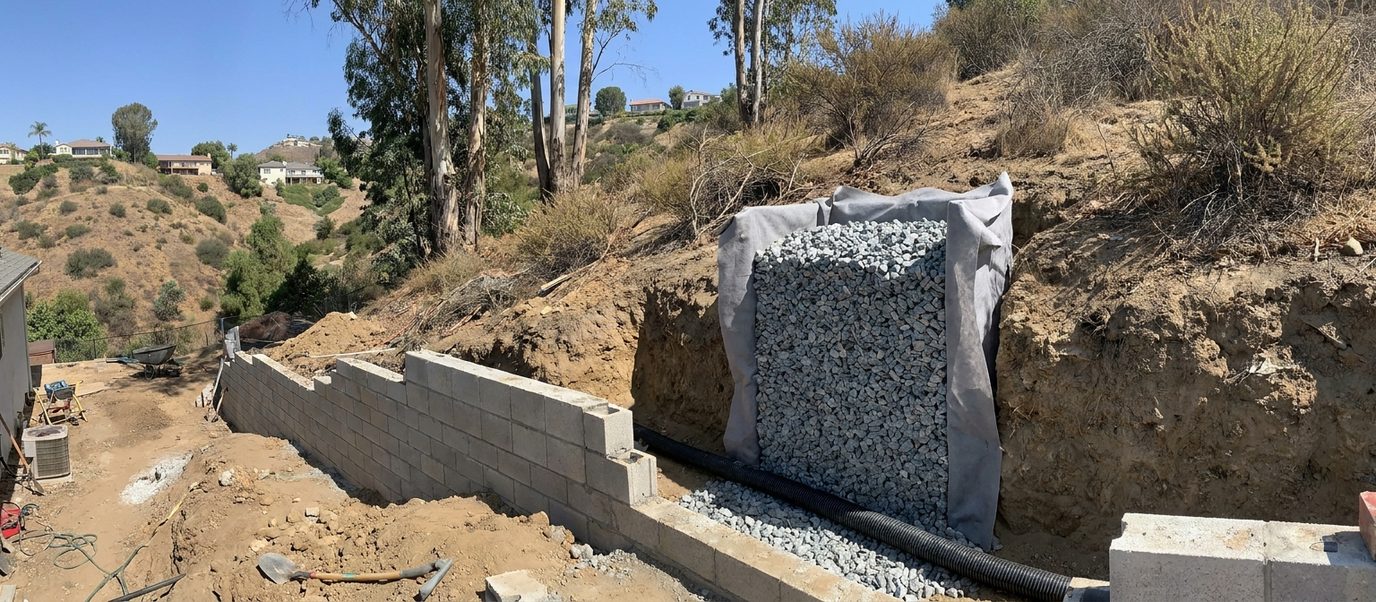
Retaining wall drainage is the system built into the space behind a wall to give groundwater somewhere to go other than against the back of the structure. In a correctly built wall it has four parts working together: a column of clean angular rock against the back face, a geotextile filter fabric separating that rock from the surrounding soil, a perforated pipe at the base to collect what comes down through it, and an outlet that carries the water somewhere legal and away from the wall.
It is not an accessory and it is not optional. Soil that has absorbed water is heavier than dry soil, and saturated soil against a wall generates hydrostatic pressure — a lateral push that can easily exceed everything the wall was designed to resist. Most walls that fail in Los Angeles were not overloaded by the slope. They were overloaded by water that had nowhere to go, which is why drainage is the first thing we look at on a retaining wall repair call and the first thing we detail on a new retaining wall installation.
The Four Parts of a Working Drainage System
Every one of these does a distinct job, and leaving any of them out eventually undoes the other three.
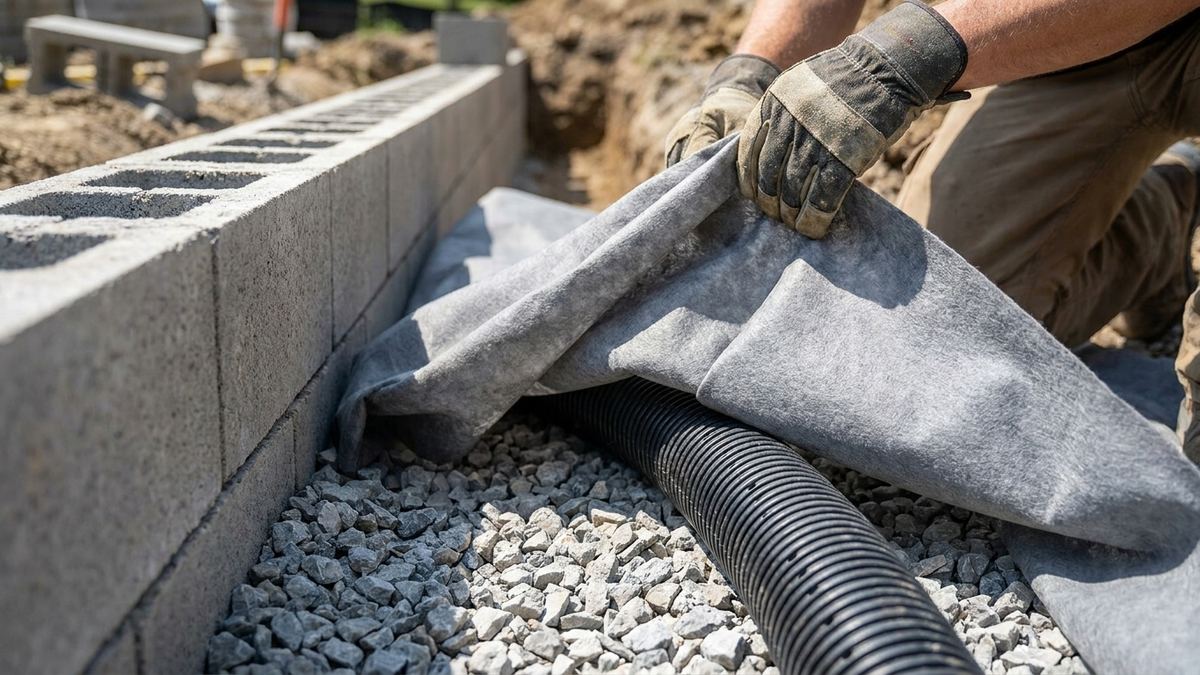
- The gravel chimney. Clean, angular, open-graded rock placed directly against the back of the wall and carried up close to finished grade. Angular rock locks together and holds its voids; rounded pea gravel packs down and stops draining.
- Geotextile filter fabric. Wrapped around the rock so fine soil particles cannot migrate into the voids. Without it the chimney silts up quietly over a few wet seasons and the wall starts behaving as though it had no drainage at all — which, by then, it doesn't.
- Perforated collector pipe. Laid at the base of the rock on a positive fall, holes down, so water entering the chimney is collected rather than pooling at the footing.
- A real outlet. The part most often skipped. The pipe has to daylight somewhere it can legally discharge, or connect to a drainage system sized to take it. A pipe that ends in the backfill is decoration.
- Weep holes where the wall type needs them. Poured concrete and CMU block walls are solid, so they need penetrations through the face for the water the chimney cannot carry away. Segmental block walls drain through their own joints; gabion baskets drain through themselves.
- Surface water handled separately. Drainage behind the wall deals with water in the soil. Water running across the surface above the wall needs its own swale or channel before it ever gets there.
Why Drainage Matters More in Los Angeles
Rain arrives all at once
LA takes a large share of its annual rainfall in a handful of intense storms. A system sized for the annual average is undersized for the day that actually matters, so we size for the peak event rather than the yearly total.
Expansive clay makes it worse
Much of the basin and the surrounding hills sits on clay that swells as it takes on water. A saturated clay backfill pushes harder and drains slower than sandy soil, so the chimney has to do more work, not less.
Irrigation runs year round
Unlike most of the country, a lot of LA walls are wet in August because of the sprinklers above them. Drainage here is not a winter-only concern.
Slopes concentrate flow
On a hillside lot, water arriving at the wall is not just what fell on it — it is what fell on everything uphill of it. Wall drainage on a slope has to be read as part of the whole lot's drainage.
How We Build the Drainage Layer
- Read the water first. Where it comes from, where it currently goes, and where it can legally be discharged. That answer drives the whole detail.
- Set the outlet before the pipe. We fix the discharge point and the fall first, then build backwards from it. Doing it the other way round is how pipes end up flat.
- Fabric, then rock, in that order. Fabric lapped generously so it stays sealed once backfill goes in over it.
- Backfill in lifts, compacted. So the wall is not carrying an uncompacted mass that settles later, and so the geogrid stays where it was placed.
- Photograph everything before it disappears. You get pictures of the rock, the fabric, the pipe and the outlet, because once the backfill goes in you cannot verify any of it.
- Test the run. Water down the pipe before backfill closes it out, to prove the fall and the outlet work.
Why Choose Us For Retaining Wall Drainage?
Drainage detailed, not assumed
It appears on the written scope with its materials and dimensions, so you can compare bids on it.
Open-graded rock, not fill sand
Specified by grading, not by whatever was cheapest to deliver that week.
Fabric on every job
The cheapest component on the list and the one that keeps the rest working.
Outlets that go somewhere
Located, fallen and proven before the trench closes.
Progress photos before backfill
The only record you will ever have of the layer you paid for.
Written workmanship warranty
At sign-off, in plain language.
Retaining Wall Drainage FAQ's
How do I know if my retaining wall has drainage?
Look for the outlet. A wall with a working system has a pipe daylighting at one or both ends, or weep holes across the face that actually run during a storm. If you see neither, and the wall is more than a couple of feet tall, assume it has none — and treat any leaning or bulging as the wall telling you so.
Can drainage be added to an existing wall?
Yes, and it is one of the most common jobs we do. It means excavating behind the wall, building the chimney and pipe properly and backfilling — a drainage retrofit. It costs far less than replacement and, on a wall that is otherwise sound, it usually removes the cause rather than treating the symptom.
Do weep holes replace a gravel drain?
No. Weep holes are the exit; the gravel chimney is the route to the exit. Holes drilled through a solid wall with saturated clay behind them will pass almost nothing, which is why drilling weeps on their own is rarely the fix people hope for.
How deep does the drain rock need to go?
It runs from the footing up towards finished grade, typically stopping just short so a soil cap keeps surface water from pouring straight into the chimney. The width depends on wall height and soil, and is one of the things a geotechnical report settles on taller walls.
Does drainage matter on a short garden wall?
Less, but not never. Below roughly two or three feet the loads are small and segmental block walls will often manage on their joints alone. Above that, on clay, in LA, it is the difference between a wall and a future repair.
What happens if the pipe gets blocked?
A silted pipe puts you back where you started, which is why the fabric matters and why the outlet should stay visible and accessible. On larger installations we leave the run rodable so it can be cleared rather than excavated.
The Rest of a Properly Built Wall
No part of an installation stands on its own: the base carries everything above it, the reinforcement decides how high it can go, the terracing decides how much of the slope you get back. Each page below covers one of those parts in detail, or start from the retaining wall installation overview.