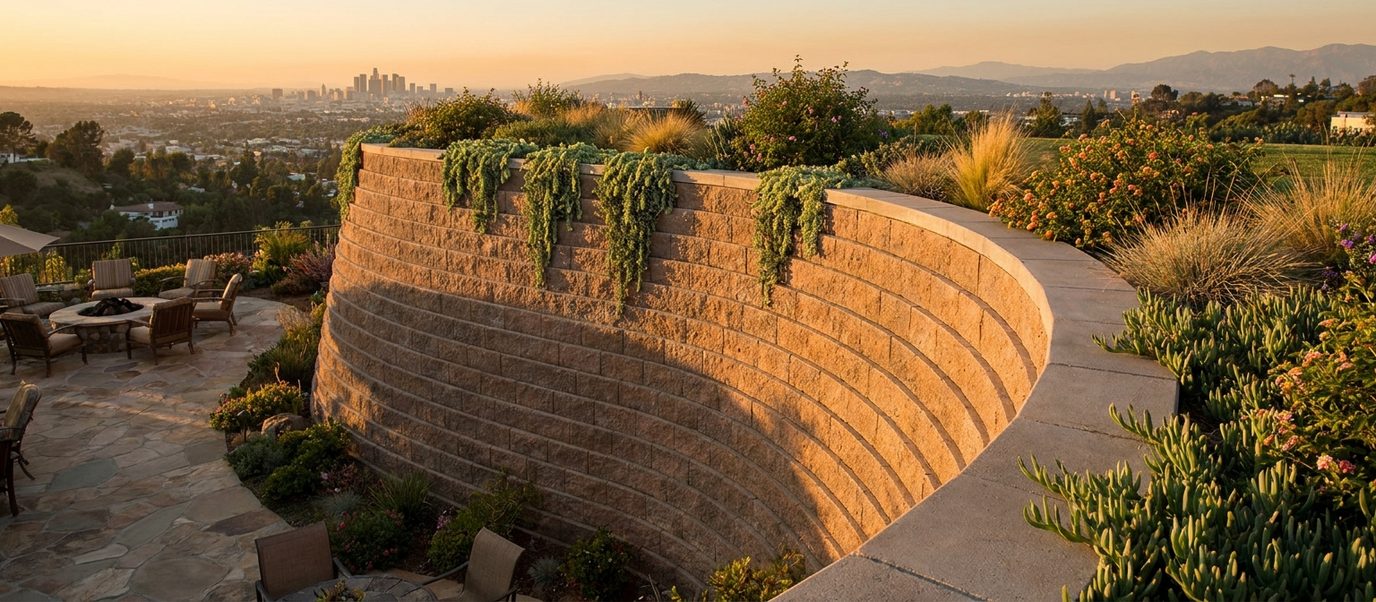
What Is a Curved Retaining Wall?
A curved retaining wall follows an arc rather than a straight line — either a single sweeping radius wrapping a patio or driveway, or a serpentine run that curves in and out along its length. In segmental systems the curve is achieved by fanning the joints between units, which is why most block is made with a tapered back: laid tight at the front, the units naturally open out at the rear and the course turns.
Curves are usually chosen for how they look, and they do transform a yard — a curved wall reads as landscape where a straight one reads as a boundary. But there is a structural argument too. An arc that curves back into the slope is inherently stiffer than a straight run, because the geometry works in compression along the face; the curve resists bowing outward in a way a flat wall cannot. Concave curves are genuinely stronger. Convex ones, curving away from the slope, are the opposite and need more attention rather than less.
What Makes a Curve Work
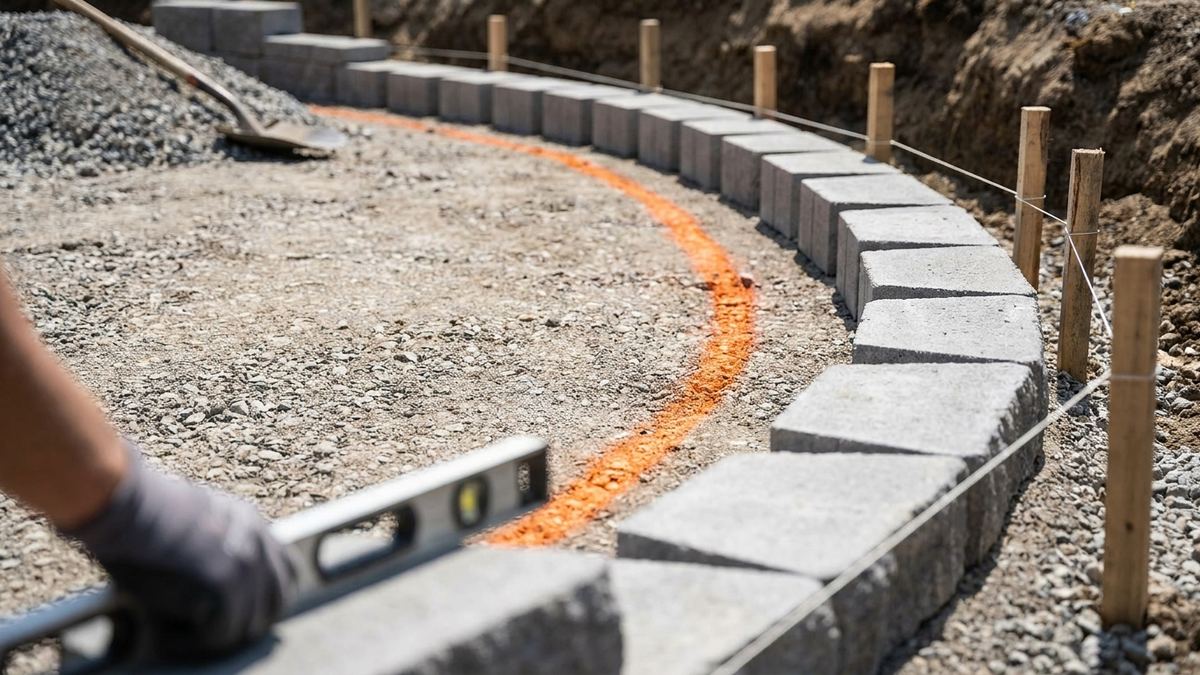
- A real radius, set out on the ground. Marked from a centre point with a tape or a string, not walked out by eye. Eyeballed curves look fine on the first course and reveal themselves as flat spots by the third.
- Minimum radius respected. Every block system has a tightest curve it can turn without splitting units. Forcing a tighter arc opens the rear joints far enough to lose interlock, which matters structurally, not just visually.
- The curve is re-set every course. The radius is checked repeatedly as the wall rises, because small errors compound and a wall that starts as an arc can finish as a series of chords.
- Cut units where the geometry demands it. Tight radii, transitions and terminations need cutting rather than forcing. A clean saw cut is invisible; a forced joint is not.
- Geogrid laid to the curve. Grid layers on a curved reinforced wall have to be cut and overlapped so coverage is continuous around the arc — the outside of a curve is where layers are most often left short.
- Drainage follows the arc. The gravel chimney and pipe curve with the wall, and the low point of the run needs finding before the pipe is laid, not after.
Where Curved Walls Belong
Wrapping a patio or seating area
The most common use, and the one where the curve does the most work — an arc encloses a space in a way a straight wall never does.
Along a driveway or turning circle
Curves follow the way vehicles actually move. On hillside driveways the wall geometry usually falls out of the turning radius rather than the other way round.
Following a natural contour
On a canyon lot the ground rarely runs straight. Letting the wall follow the contour cuts excavation and makes the finished wall look inevitable rather than imposed.
Combined with terracing
Curved tiers are the signature look of a well-built LA hillside garden. See tiered and terraced walls for how the setbacks have to work underneath that look.
Where curves get expensive
Very tight radii, serpentine runs with repeated direction changes, and curves in concrete retaining walls or stone and boulder walls where the formwork or the stone cutting carries the cost rather than the wall itself.
How We Build a Curved Wall
- Set out and review before digging. The arc is marked on the ground with paint and stakes and looked at from the house, the patio and the street, because a curve that works on a plan does not always work from the places people stand.
- Excavate the trench to the curve. Wide enough for the base material around the full arc, not a straight trench with a curved wall in it.
- Level the base around the arc. Compacted base on a curve is slower, because the level has to be checked radially as well as along the run.
- Fan the joints, don't force them. Units laid tight at the face with the taper doing the work, and cut where the radius is tighter than the system allows.
- Check the radius as the wall rises. From the centre point, course by course, so the arc stays true to the cap.
- Cap and finish deliberately. Cap units cut to the curve and bonded, with the terminations resolved rather than left to run out.
Why Choose Us For Curved Retaining Walls?
Curves set out from a centre point
Measured, marked and reviewed on site before anything is dug.
Minimum radius respected
We cut units rather than forcing joints open.
Radius checked course by course
So the finished arc is an arc, not a set of chords.
Reinforcement continuous around the curve
Grid cut and overlapped so the outside of the arc is not the weak point.
Clean terminations and cap cuts
The details that decide whether the wall looks made or assembled.
Written workmanship warranty
At sign-off, in plain language.
Curved Retaining Wall FAQ's
Are curved retaining walls stronger than straight ones?
A concave curve — one bending back into the slope — is genuinely stiffer, because the arc resists outward movement through its geometry. A convex curve is not; it is the more demanding case and needs the reinforcement and drainage treated carefully rather than assumed.
Do curved walls cost more?
Modestly, on block. The extra is layout time, cutting and slower base work rather than materials. On concrete retaining walls the difference is larger because curved formwork is a real cost, and on stone and boulder walls larger again because every stone at the face has to be selected and cut to the arc.
How tight can a curve be?
It depends on the block system, and each has a stated minimum radius. Tighter than that and units have to be cut, which is normal and fine — what is not fine is forcing the joints open and losing the interlock that holds the course together.
Can an existing straight wall be curved?
Not by modifying it. Changing the alignment means rebuilding from the base, so in practice it is a wall replacement conversation — which is often the right moment to do it, if the wall was due for work anyway.
Do curved walls still need drainage and reinforcement?
Every bit as much, and the curve makes both slightly harder to get right. The gravel chimney has to follow the arc and the geogrid has to be cut and overlapped around it — the outside of a curve is exactly where layers get left short.
Which wall types curve well?
Block retaining walls is the easiest by a distance, because the units are made for it. Stone and boulder walls and gabion baskets curve well by nature. Concrete retaining walls can be curved but the formwork is the cost, and shotcrete is excellent on curves since it is sprayed to whatever shape the face is built to.
The Rest of a Properly Built Wall
No part of an installation stands on its own: the base carries everything above it, the drainage layer decides what the wall has to resist, the reinforcement decides how high it can go. Each page below covers one of those parts in detail, or start from the retaining wall installation overview.