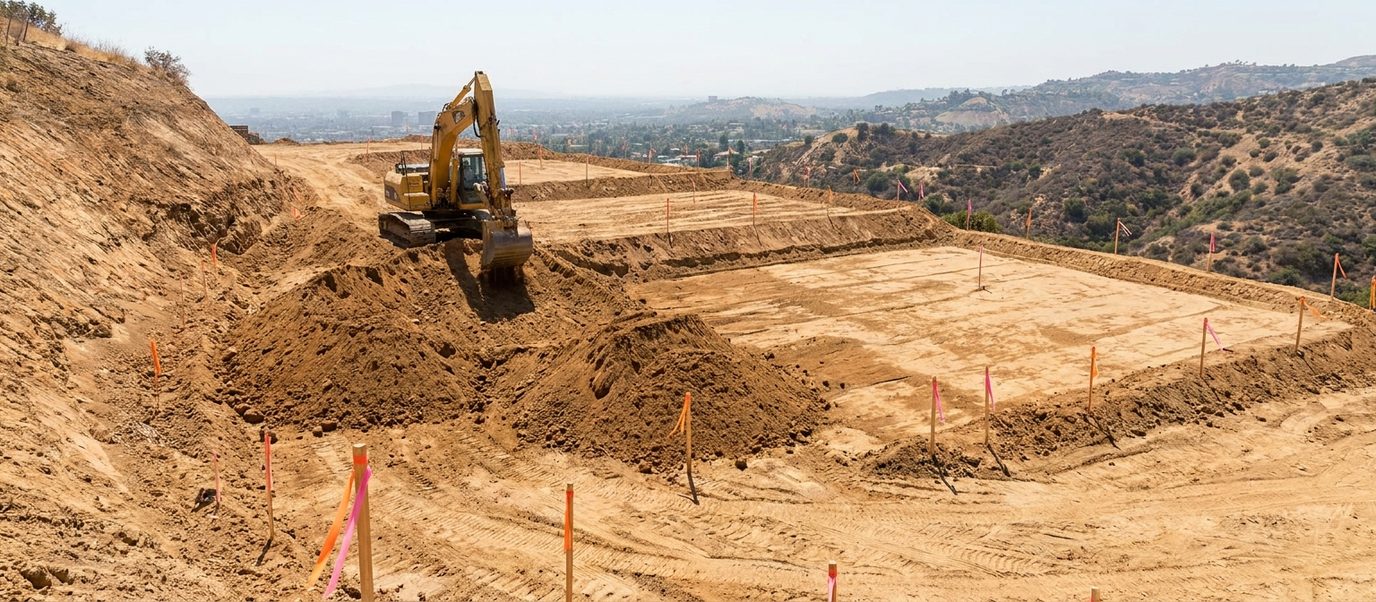
What Is Hillside Grading?
Grading is the controlled reshaping of a site: cutting material out of the high side, placing and compacting it as engineered fill on the low side, benching the interfaces so cut and fill lock together, and setting the finished surfaces to drain where they are supposed to. On a hillside lot it is the operation that creates a level pad, a driveway that a car can actually climb, or a yard where there was only slope.
Grading and walls trade against each other, and that trade is where most of the money on a hillside project sits. Cut more and you need less wall; cut less and the wall gets taller, which usually means engineering, deeper footings and possibly drilled caissons. There is generally an optimum somewhere in between, and finding it before the design is fixed is worth more than any efficiency found later on site.
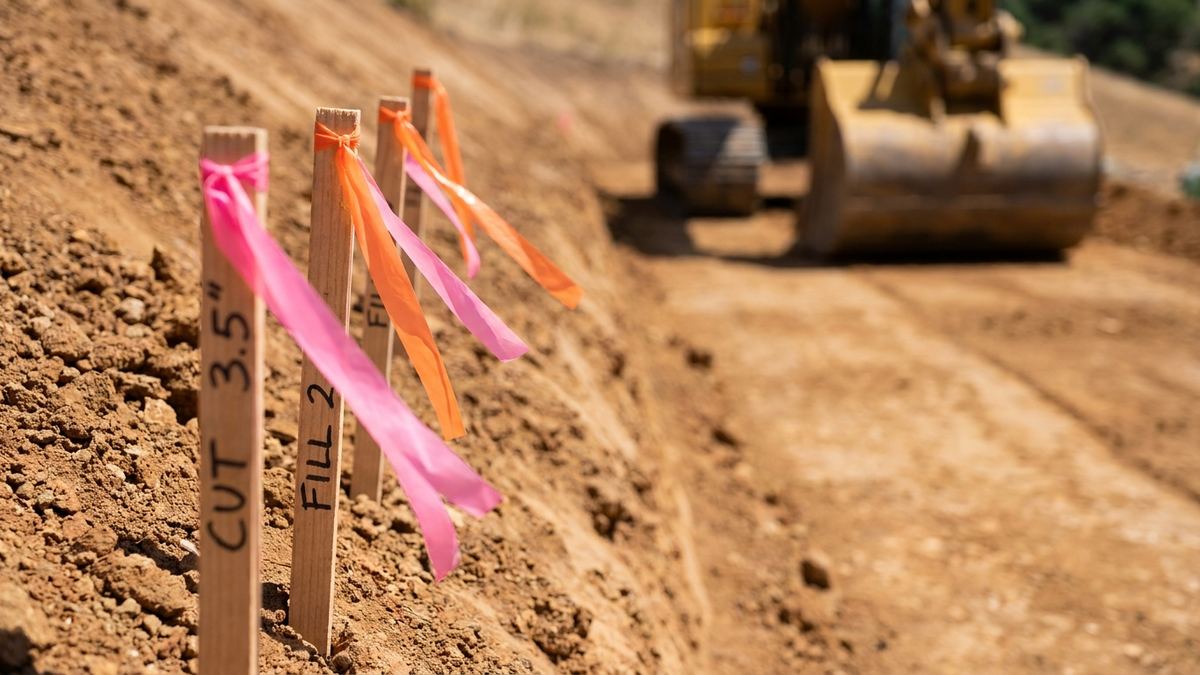
What Makes Hillside Grading Work
- Cut and fill balanced where possible. Material moved on site is far cheaper than material exported or imported. A design that balances is a design that costs less, and on constrained LA lots export trucking is a real line item.
- Fill placed as engineered fill. In compacted lifts, to a specified density, tested. Uncontrolled fill is the origin of an enormous share of hillside problems in this city, and it is created by exactly this operation done badly.
- Cut and fill interfaces benched. Keyed and stepped so fill placed against a cut slope cannot slide along the join. A smooth interface is a built-in failure surface.
- Slope angles that stand up. Cut and fill faces graded to angles the material can hold, which differ — fill will not stand as steep as cut in the same soil.
- Drainage designed into the shape. Falls, swales, brow ditches above cut faces and terrace drains on tall slopes, all set as part of the grading rather than added afterwards. Related to but separate from wall drainage.
- Surfaces protected before the rains. A freshly graded slope is at its most vulnerable the day the machines leave — see slope stabilization for how that is handled.
Where Grading Earns Its Keep
Creating a usable pad
The classic hillside job: a level area for a house, an ADU, a pool or a garage, cut into ground that had none.
Reducing the wall you need
Often the highest-value use of grading. Pulling a slope back or splitting it into terracing can turn one tall engineered wall into two modest ones.
Driveways and access
Hillside driveway gradients are constrained by code and by what a vehicle can actually use. Access grading frequently drives the whole site layout rather than following it.
Fixing an earlier grading job
Removing and re-placing uncontrolled fill left by previous work. Unglamorous, and on many LA lots the single most valuable thing that can be done.
Where grading is not the answer
Lots with no room to cut, protected trees or habitat, boundaries too close, or export volumes that make the trucking uneconomic. There the wall does the work instead, and drilled caissons or tiebacks becomes the discussion.
How We Handle Hillside Grading
- Survey before design. Existing contours measured rather than estimated, because cut and fill volumes calculated off a guess are a guess.
- Test what is already there. Locating existing fill and its depth changes the whole plan, and it is better found in a test pit than under a finished pad.
- Plan haul routes and export early. On narrow hillside streets this constrains everything, including what size machine can get on site at all.
- Bench and key every interface. Documented as it is built, because it disappears under the next lift.
- Compact and test to spec. Density testing on engineered fill, with the results kept — they matter at inspection and at resale.
- Protect the surfaces on the way out. Matting, hydroseed or temporary drainage before the site is left, not after the first forecast.
Why Choose Us For Hillside Grading?
Grading and wall priced together
So you can see the trade rather than being handed one option.
Existing fill investigated first
Because it changes both the plan and the price.
Fill placed and tested properly
With the compaction results retained.
Interfaces benched and keyed
The detail that separates engineered fill from a future slide.
Drainage built into the shape
Not added once the earth has stopped moving.
Written workmanship warranty
At sign-off, in plain language.
Hillside Grading FAQ's
Do I need a permit to grade my hillside?
Almost certainly, once the volume or the depth of cut and fill passes the thresholds set locally, and hillside areas in the City and County of Los Angeles are reviewed more closely than flat lots. Grading in a designated hillside area also brings its own set of requirements, which is a design-stage conversation.
Is grading cheaper than building a taller wall?
Frequently, up to the point where export trucking takes over. Moving material within a site is inexpensive; hauling it off a narrow hillside street is not. The crossover point is what we work out at design stage, and it is site-specific rather than general.
What is engineered fill?
Fill placed in controlled lifts, at a controlled moisture content, compacted to a specified density and tested. It is a structural material. What it is not is soil pushed over the edge and levelled, which is what a great deal of older LA hillside fill actually is.
Can I build on existing fill?
Not without knowing what it is. Older uncontrolled fill has to be removed and re-placed, or the structure founded through it — which is one of the situations that leads to drilled caissons. Establishing which applies starts with a test pit and a soils report.
How does grading affect my neighbours?
On a hillside, materially. Changing where water runs, undercutting or surcharging a neighbouring slope, and haul traffic on a shared street are all real considerations, and some of them have legal weight. They belong in the design, not in a conversation after the fact.
When is the best time to grade in Los Angeles?
Late spring through early autumn. The material is workable, compaction is achievable, and there is time to establish protection before the rains. Winter grading is possible but slower, and carries a genuine risk of leaving exposed ground in front of a storm.
The Rest of the Hillside Picture
A hillside wall is rarely the whole problem: what the slope is doing decides whether a wall is even the right tool, what the wall is founded on decides how tall it can go, which way the ground falls decides most of the rest. Each page below covers one of those in detail, or start from the hillside retaining walls overview.